
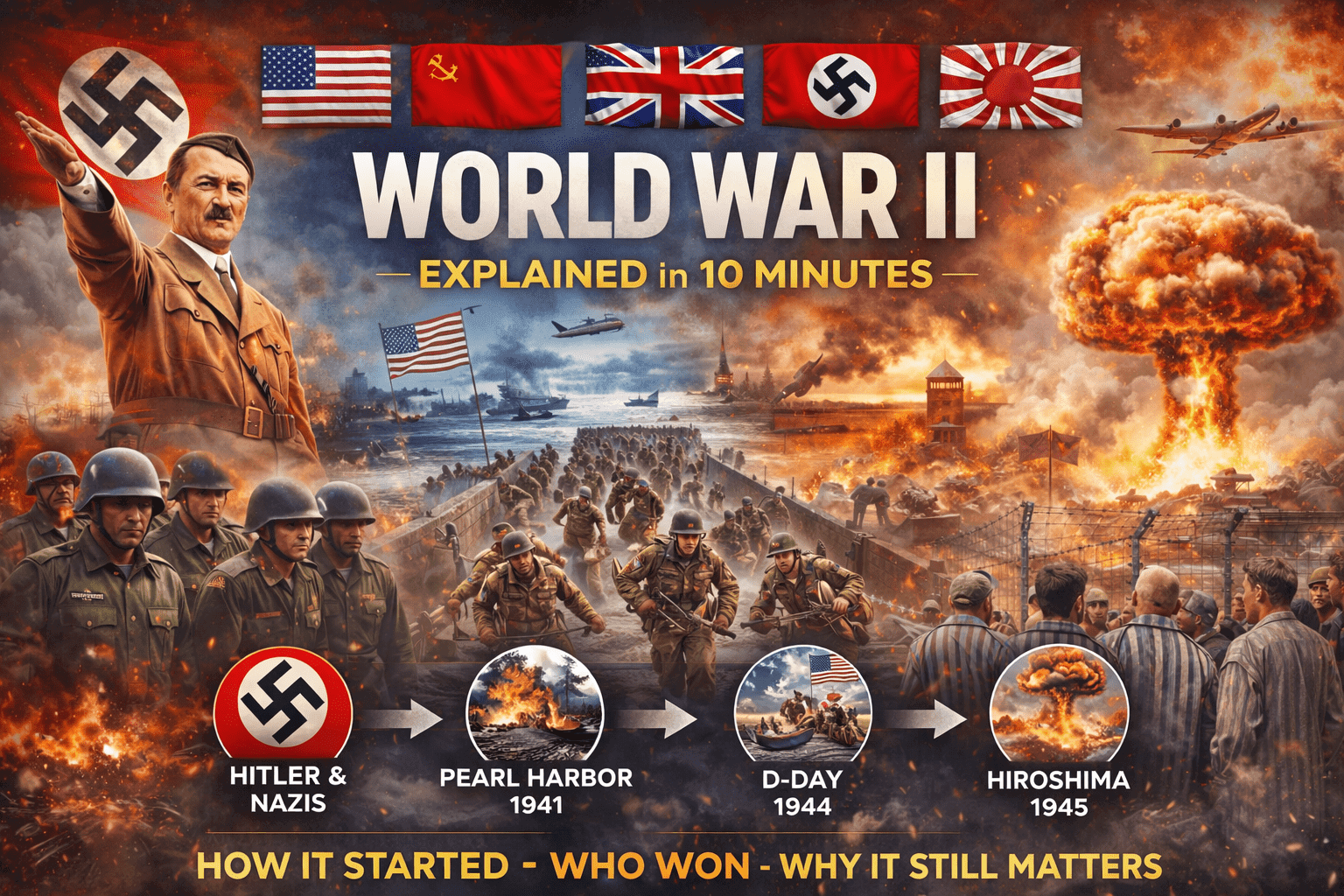
World War II (commonly called WW2) was the largest and deadliest conflict in modern history. It reshaped borders, ended empires, created new superpowers, and still affects politics, technology, and world relations today.
Timeline: WW2 is generally dated from 1939 to 1945.
What Was World War II?
WW2 was a global war fought mainly between two alliances:
- Allies: primarily the United Kingdom, the Soviet Union, the United States, China (plus many others)
- Axis Powers: primarily Nazi Germany, Imperial Japan, Fascist Italy (plus partners)
The fighting spread across Europe, North Africa, and Asia-Pacific, involving massive armies, air forces, navies, and civilians on an unprecedented scale.
Why Did WW2 Start? (Simple Reasons)
WW2 didn’t start from one single event. It built up over years. The biggest causes are usually explained like this:
1) The aftermath of World War I
After WW1, Germany faced harsh economic and political pressure, which helped extremist movements grow.
2) The rise of aggressive dictatorships
- In Germany, Adolf Hitler and the Nazi Party gained power and pushed expansion.
- In Japan, military leaders sought resources and territory across Asia.
- In Italy, Mussolini promoted imperial expansion.
3) Expansion and “appeasement”
Germany took bold steps—rearming and expanding—while some European powers tried to avoid war through negotiation.
4) The trigger event (Europe)
In September 1939, Germany invaded Poland, and Britain and France declared war—this is widely treated as the “start” of WW2 in Europe.
(Note: In Asia, Japan’s major expansion began earlier, especially in China.)
The War in Europe: Key Turning Points
Battle of Britain (1940)
Britain resisted Germany’s air campaign, preventing an invasion.
Operation Barbarossa (1941)
Germany invaded the Soviet Union, opening the massive Eastern Front.
Stalingrad (1942–43)
A decisive Soviet victory that pushed Germany onto the defensive.
D-Day / Normandy Landings (June 6, 1944)
Allied forces landed in Nazi-occupied France and opened a western front that accelerated Germany’s defeat.
Fall of Berlin & Germany’s surrender (1945)
Germany surrendered in May 1945, often marked by V-E Day (Victory in Europe Day) celebrations.
The War in the Pacific: Key Turning Points
Pearl Harbor (Dec 1941)
Japan attacked the U.S. naval base at Pearl Harbor, bringing the United States fully into the war.
Midway (1942)
A major U.S. naval victory that shifted momentum against Japan.
Island-Hopping Campaign
The Allies advanced across the Pacific, capturing strategic islands to move closer to Japan.
Hiroshima & Nagasaki (August 1945)
The U.S. dropped atomic bombs on Hiroshima and Nagasaki, and Japan surrendered shortly after.
Who Won World War II?
✅ The Allies won.
Germany surrendered in May 1945, and Japan surrendered in August 1945, ending WW2.
How Many People Died?
WW2 caused enormous military and civilian losses, including genocide and mass bombings. Most credible historical summaries describe tens of millions of deaths worldwide, making it the deadliest conflict in human history.
The Holocaust (A Critical Part of WW2)
During WW2, Nazi Germany carried out the Holocaust, the systematic murder of six million Jews, along with millions of other victims (Roma, disabled people, political prisoners, and more). This remains one of the most documented crimes in history and is central to understanding why WW2 is remembered so intensely.
Why WW2 Still Matters Today
WW2 shaped the modern world in big ways:
- The United Nations was formed to prevent future global wars.
- The U.S. and the Soviet Union emerged as superpowers, leading into the Cold War.
- Many countries gained independence as empires weakened after the war.
- Technology accelerated: radar, jet engines, rockets, computing—and nuclear weapons.