 Arsalan Shaikh Vohra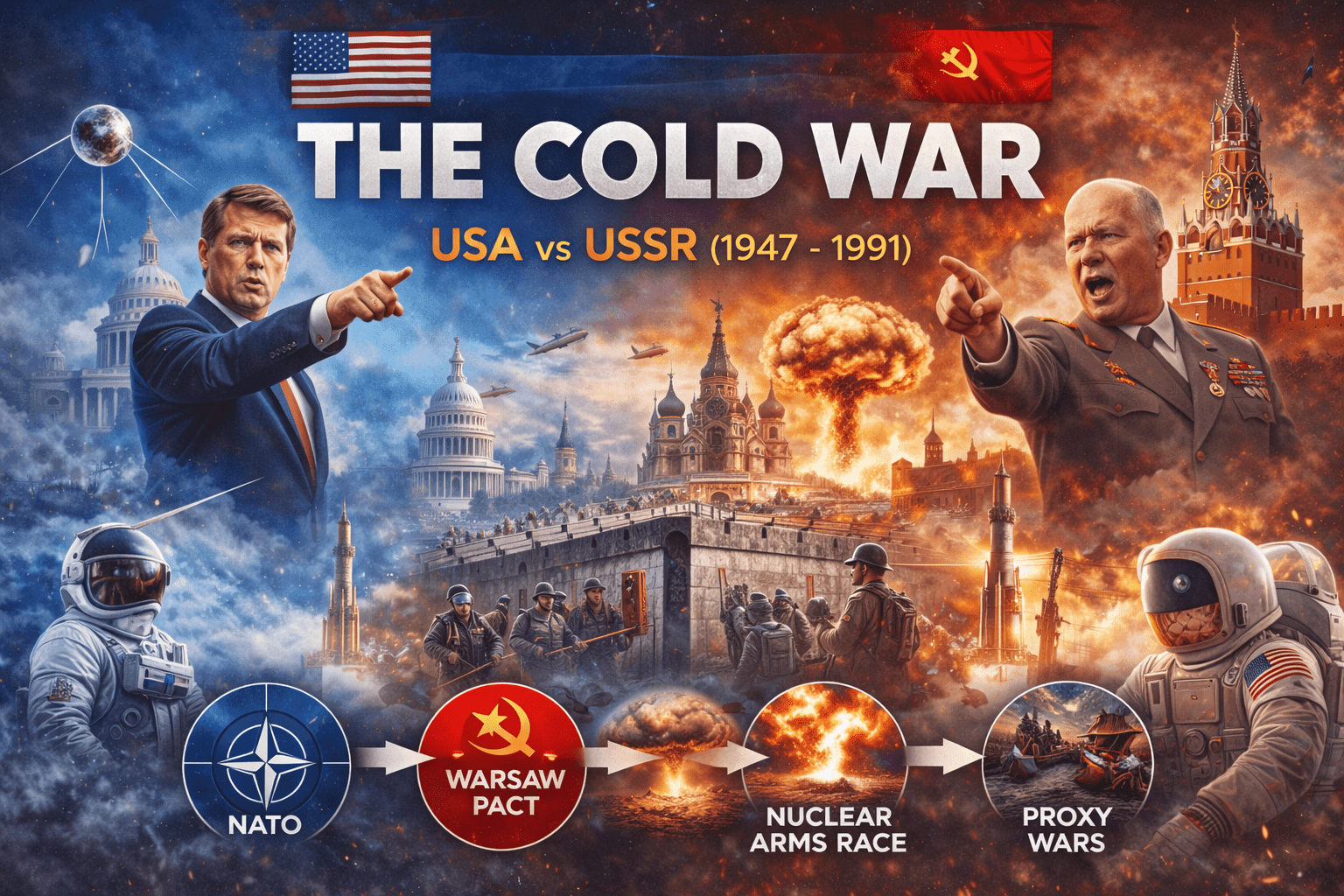
If World War II was a huge explosion, the Cold War was the long, tense silence afterward—where everyone knew something could go wrong at any moment, but nobody wanted to be the one to start the next world war.
The Cold War was mainly a global power struggle between two superpowers: the United States and the Soviet Union (USSR). It didn’t look like a normal war with one clear battlefield. Instead, it felt like a constant contest—who controls the future, who influences more countries, who has the strongest military, who wins the public opinion, and who reaches the next technological milestone first.
Most historians roughly place it from about 1947 to 1991, though the tension began building immediately after WWII ended.
How it really started (in simple terms)
After WWII, Europe was broken. Cities were destroyed, economies collapsed, and millions of people were displaced. The old big empires were weak. Out of that chaos, two countries stood tall:
- The United States, economically powerful and increasingly influential in the West
- The Soviet Union, with a massive army and strong control over Eastern Europe
Now here’s the key: they weren’t just competing for land. They were competing for systems—for how countries should run.
- The US model: elections, multiple parties (at least in theory), capitalism, private business, open trade
- The Soviet model: one-party communist system, state control of the economy, strict political control
Both believed their way was the “correct” future. And both feared the other’s system spreading.
So imagine this: the US looked at the USSR and thought, “If communism spreads, we lose allies and power.”
The USSR looked at the US and thought, “If capitalism surrounds us, we’ll be attacked or undermined.”
That fear created the Cold War mindset: trust nobody, build power, and stop the other side from expanding.
Why it’s called “Cold”
Because the US and USSR didn’t fight each other directly in a full-scale war like WW2. They avoided that because by the late 1940s and 1950s, both sides had something terrifying: nuclear weapons.
Once both sides had nukes, direct war meant possible total destruction. This created a strange balance called deterrence—basically:
“If you hit me, you die too.”
So instead of fighting each other head-on, they fought indirectly using:
- proxy wars (other countries became battlefields)
- spying (CIA vs KGB, intelligence wars)
- propaganda (controlling what people believe)
- arms races (bigger bombs, more missiles)
- science races (space and tech competition)
Berlin became the symbol of the whole Cold War
Berlin was like a living map of the conflict. After WWII, Germany was divided, and Berlin—inside Soviet-controlled East Germany—was also divided.
When the Soviets tried to cut off West Berlin (the Berlin Blockade), the West responded by flying supplies into the city for months (the Berlin Airlift). It was a big moment because it showed the world: “This is no longer about WW2. This is the next conflict.”
Later, the Berlin Wall (1961) became the most famous symbol of division. It wasn’t just a wall—it was a message:
“Two worlds, two systems, no easy crossing.”
The world turned into a chessboard (proxy wars)
This is where the Cold War becomes very real and very brutal. Because even if the US and USSR didn’t fight directly, millions of people in other countries suffered as these superpowers competed.
Some major examples:
- Korean War (1950–1953): A divided peninsula turned into a battlefield.
- Vietnam War (1955–1975): A long, painful war tied to fears of communism spreading.
- Conflicts and coups in parts of Latin America, Africa, and Asia often had Cold War fingerprints—funding, weapons, political support, or interference.
The pattern was simple:
- If a country leaned communist, the US often tried to stop it.
- If a country leaned capitalist/western, the USSR often tried to counter it.
Sometimes it looked like “help.” Many times it looked like control.
The nuclear nightmare: Cuban Missile Crisis
If you ever want the moment when the world felt closest to nuclear war, it’s the Cuban Missile Crisis (1962).
The USSR placed nuclear missiles in Cuba, very close to the US. The US responded with a naval blockade and demanded removal. For days, the world held its breath. One wrong decision could have triggered nuclear exchange.
In the end, both sides stepped back. But the crisis proved something permanently:
This rivalry could end the world.
After that, both sides became slightly more careful, even while they kept competing.
The Space Race: rockets, pride, and power
The Cold War wasn’t only about fear—it was also about showing superiority.
When the USSR launched Sputnik, it shocked the US and changed education, research, and technology priorities. Later, the US pushed hard and landed humans on the Moon in 1969.
Space became a symbol. Not just science—national prestige.
Behind the scenes, space technology was tied to missiles and military capability too. If you can launch a rocket to space, you can launch a missile across continents.
So how did it end?
The Cold War ended not with one dramatic surrender, but with a slow collapse of the Soviet system.
By the 1980s:
- the USSR was spending huge money on the military
- the economy struggled to deliver consumer goods and living standards
- political dissatisfaction grew
- Eastern European countries began pushing back harder
Reforms tried to open things up, but that also loosened control. Once the Soviet grip weakened, countries in Eastern Europe moved toward independence and change. The Berlin Wall fell in 1989, and that felt like the world’s biggest “turning point” moment.
Finally, in 1991, the Soviet Union dissolved. And with that, the Cold War was basically over.
Why it still matters (even today)
Even though the Cold War ended, it shaped the modern world in a way you still feel today:
- alliances like NATO still exist and influence global politics
- nuclear weapons are still a major global threat
- many modern conflicts and tensions have roots in Cold War decisions
- technology, surveillance, intelligence agencies—much of it expanded massively during Cold War competition
In short: the Cold War didn’t just change borders. It changed how countries think, how they plan security, and how global power works.
