 Arsalan Shaikh Vohra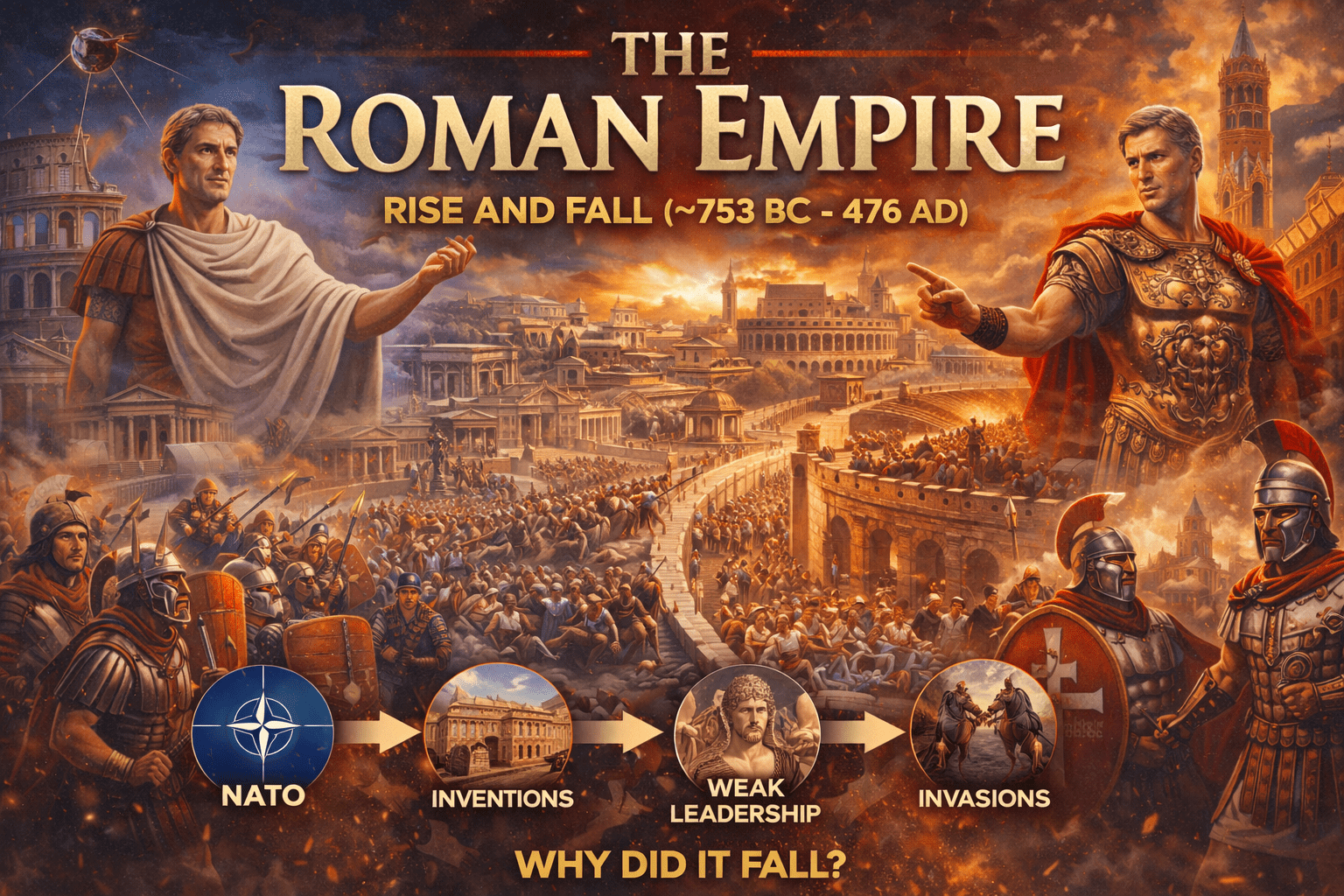
When people search history on Google, one topic always comes up again and again: The Roman Empire.
Why? Because Rome wasn’t just an empire. It was a civilization that shaped law, politics, architecture, language, military strategy—and even the calendar you use today.
The Roman Empire didn’t appear overnight. It started small, grew powerful through discipline and ambition, ruled vast lands for centuries, and then slowly collapsed under its own weight.
Let’s break it down in a simple, human way.
How Rome Started (From Village to Power)
Rome began as a small settlement around 753 BC (according to legend). At first, it wasn’t even an empire—it was a kingdom. Later, it became a Republic.
During the Republic (around 509 BC onward), Rome was ruled by elected officials and a Senate. This system gave Rome political stability and helped it expand.
Rome expanded step by step:
- First across Italy
- Then defeating Carthage in the Punic Wars
- Then taking control of Greece
- Then parts of North Africa
- Then the Middle East
Rome didn’t just conquer with force—it built roads, alliances, and systems. Roman roads were so well built that many still exist today.
How Rome Became an Empire
The Republic eventually faced internal corruption, power struggles, and civil wars. One of the most famous figures during this time was Julius Caesar.
Caesar became extremely powerful, but in 44 BC, he was assassinated by senators who feared he would become a dictator.
After more chaos and civil war, his adopted heir Octavian (Augustus) became Rome’s first emperor in 27 BC. This marks the beginning of the Roman Empire.
From that point, Rome was ruled by emperors instead of elected leaders.
The Golden Age of Rome
Under emperors like Augustus, Trajan, and Hadrian, Rome reached its peak.
At its height, the Roman Empire stretched from:
- Britain
- Across Europe
- Into North Africa
- Through the Middle East
It surrounded the Mediterranean Sea so completely that Romans called it “Mare Nostrum” — “Our Sea.”
Rome was powerful because of:
1. Military Discipline
The Roman legions were highly trained, organized, and loyal.
2. Engineering
Aqueducts, roads, bridges, amphitheaters, and massive cities.
3. Law
Roman law became the foundation for many modern legal systems.
4. Infrastructure
Trade networks connected distant regions efficiently.
Daily Life in Rome
Rome wasn’t just soldiers and emperors. It was:
- Crowded cities
- Public baths
- Gladiator games in the Colosseum
- Political debates in the Forum
- Slavery (which powered much of the economy)
Citizens had rights. Non-citizens did not. Social class mattered a lot.
Why the Roman Empire Fell
This is one of the most searched history questions:
Why did the Roman Empire fall?
The answer isn’t simple—it was a combination of problems over time.
1. Political Instability
Emperors were often overthrown or assassinated. Leadership was unstable.
2. Economic Problems
Heavy taxes, inflation, and reliance on slave labor weakened the economy.
3. Military Pressure
Germanic tribes and other groups pushed into Roman territory.
4. Division of the Empire
Rome split into:
- Western Roman Empire
- Eastern Roman Empire (Byzantine Empire)
The Western Roman Empire officially fell in 476 AD when the last emperor was removed.
However, the Eastern Roman Empire (Byzantine Empire) survived for nearly another 1,000 years.
Did Rome Really “Fall”?
Interestingly, Rome never fully disappeared.
- Roman law influenced Europe.
- Latin became the base for languages like Spanish, French, and Italian.
- Roman architecture influenced churches and government buildings.
- The idea of a republic influenced modern democracies.
Even the term “Senate” comes from Rome.
In many ways, Rome didn’t fall—it transformed.
Why People Still Search the Roman Empire
Because Rome feels modern.
You can still:
- Walk on Roman roads
- See Roman ruins
- Study Roman law
- Use Latin-based words
It’s one of the rare civilizations whose influence still shapes everyday life.
